The client is an international non-profit organization committed to improving access to quality education for underserved communities. Through a network of educational institutions and child development programs, the organization delivers education alongside healthcare, nutrition, and family support initiatives, helping children and their families build a stronger future.
Client
The client is an international non-profit organization committed to improving access to quality education for underserved communities. Through a network of educational institutions and child development programs, the organization delivers education alongside healthcare, nutrition, and family support initiatives, helping children and their families build a stronger future.
Challenges
The client’s school administrators and finance teams managed student fee payments, tracked pending fees, and supported parents with fee-related queries. As payment volumes increased and transactions were received through different methods, maintaining accurate fee records became more demanding:
- Multiple payment methods needed consistent processing: Payments received through mobile payment services, cheques, donor contributions, and bursaries each required different information, making it difficult to maintain a consistent fee collection process.
- Direct digital payments required careful verification: When parents made payments through the school’s mobile payment platform, every transaction had to be manually matched with the correct student before it could be reflected in the fee records.
- Extra effort was needed to track excess payments: Parents sometimes paid more than the amount due or chose to pay future fees in advance whenever they had the opportunity. These excess amounts had to be tracked and manually adjusted against upcoming fee schedules.
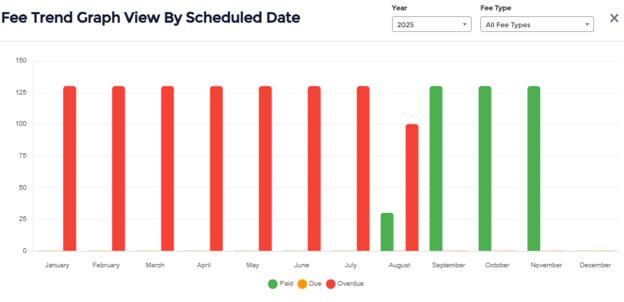
- Payment records were difficult to review together: Reviewing overdue fees, completed payments, excess balances, and sibling fee records together before processing payments required additional effort from finance teams.
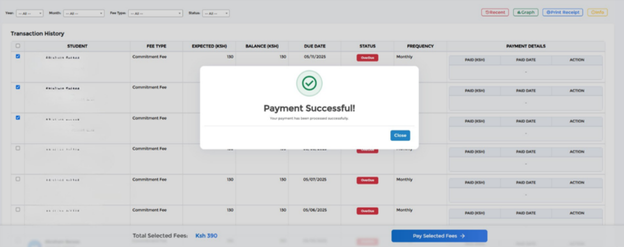
- Families had to complete separate transactions: Parents with more than one child had to make separate fee payments for each student, even when they wanted to pay all the fees at once. This increased the number of payment transactions and the transaction charges they had to bear.
Solution
After understanding the school’s fee collection process and the challenges faced by its finance teams, UBTI designed and implemented a unified fee management solution to simplify the collection, validation, recording, and tracking of student payments through a single interface. The solution uses ASP.NET Core for the application, REST APIs, and Webhooks to securely connect with the mobile payment service, and Azure SignalR to provide real-time payment updates within the portal:
- Supports multiple payment methods through a single screen: When finance teams select a payment method, the system auto-displays only the information required for that payment type. This allows different payment methods to be recorded through one consistent process.
- Validates and records digital payments automatically: When parents complete a payment through the integrated mobile payment service, the system validates the student details, records the transaction against the correct student, and instantly updates the payment status for the finance team.
- Processes one payment for multiple siblings: When parents choose to pay the fees for multiple children in one transaction, the system automatically allocates the payment across each student’s fee schedule while maintaining separate fee records.
- Tracks excess payments for future fee schedules: If a parent pays more than the current amount due, the extra amount is stored as an excess fee balance. When the next fee payment is due, the system automatically adjusts this available balance to offset the outstanding amount.
- Displays complete payment details in one place: Finance teams can view overdue fees, completed payments, excess balances, sibling fee details, payment schedules, and payment history from a single screen. Real-time payment status and notifications also help administrators stay informed throughout the process.


Outcome
Rather than treating every payment as a separate administrative task, UBTI helped the school create a connected fee management process. Whether handling different payment methods, sibling payments, or future fee adjustments, finance teams could now manage the entire payment journey through a single workflow. This helped the client:
- Create a more consistent fee collection process: Finance teams could follow the same workflow regardless of the mode of payment, helping standardize day-to-day fee collection activities.
- Simplify fee payments for families: Parents with more than one child could pay all fees in a single transaction instead of making separate payments for each student, helping reduce unnecessary transaction charges.
- Make student payment records easier to review: Finance teams could review outstanding fees, completed payments, excess balances, sibling records, and payment history together, making it easier to understand each student’s payment status before processing payments.
- Advance payments are automatically managed: If parents pay extra or prepay future fees, the system tracks and applies the balance automatically without requiring follow-ups.
- Provided greater confidence in payment records: All student payments are validated and reflected in the system automatically, reducing uncertainty about a child’s fee status.
- Improve payment accuracy: Automated validation and allocation reduce the chances of fee payments being recorded against the wrong student.
Conclusion
Managing fee collections, payment records, sibling accounts, and excess fee adjustments became increasingly demanding as the number of students and transactions grew in the client’s school. This made it increasingly important to maintain accurate records, improve payment visibility, and create a consistent process across different payment methods. By implementing an integrated fee management solution with secure digital payment connectivity, UBTI reduced administrative effort, improved transaction visibility, and created a consistent payment experience for finance teams and parents alike. UB Technology Innovations, Inc. continues to support educational institutions with future-ready fee management solutions that empower finance teams, simplify the payment experience for families, and help create a more connected and efficient learning ecosystem.